Monthly Mosh Pit (News Roundup) - Nov25
Big Tech news is horrifying, but don't be angry about it every day. Instead focus your rage in the mosh pit once a month 🤘🏼 with our news roundup, then get back to your life!

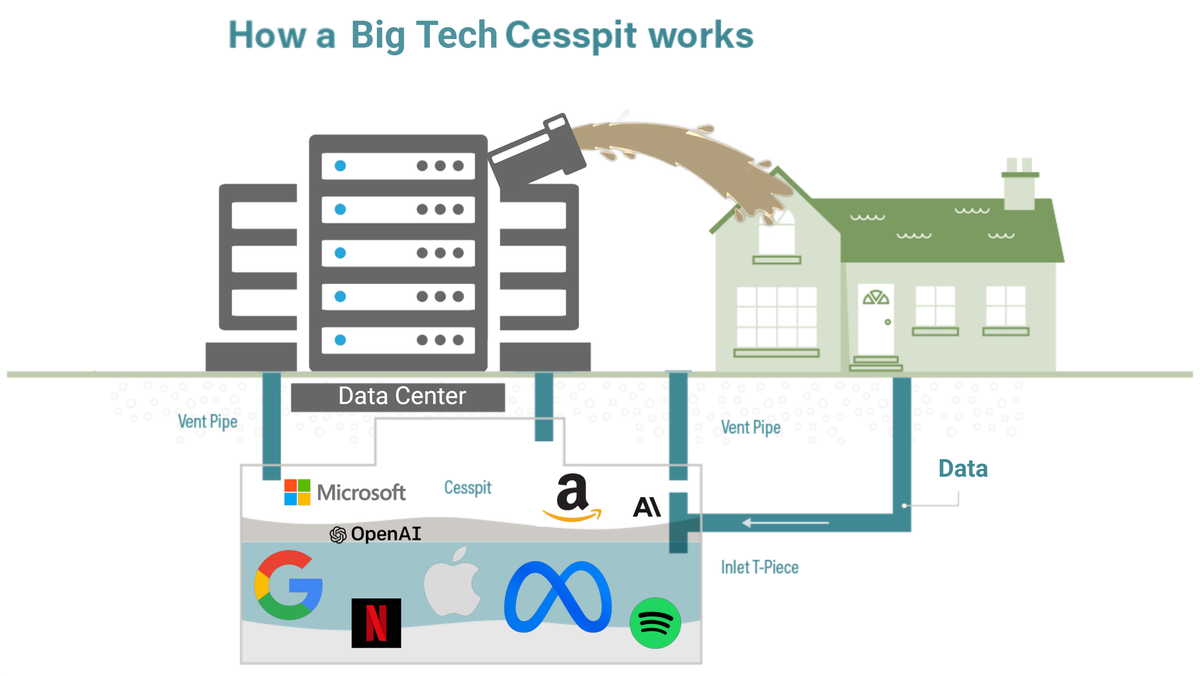
Big tech constantly gaslights you about how wonderful they are. We're here to inform you otherwise. And to show you all the great ethical alternatives.
Here's our roundup of noteworthy stuff from November 2025.
Big tech cesspit
Meta keep plumbing deeper depths of awful
EVERY WhatsApp number leakable! Big Tech security fail
 Andy Greenberg
Alternative link: https://www.heise.de/en/news/3-5-Billion-Accounts-Complete-WhatsApp-Directory-Retrieved-and-Evaluated-11083244.html
One of the retorts you hear from big tech apologists is "but at least they're secure, so I trust them". Well. Researchers just proved that wrong. They discovered a back door in Meta's WhatsApp - and could access all 3.5 billion phone numbers in the database. And your profile photo.
The researchers tried to warn Meta about this flaw back in 2017 but were ignored. In September 2024 they tried again but were ignored. Meta just don't care about you. But in late 2025 they submitted their full paper and proved they had accessed ALL the numbers. Finally Meta did something, and say they are fixing it. Don't trust them.
Meta reveals that all chats with its AI chatbots will be read by them
 Viviane Osswald
(Same link without 'pay or ok paywall': https://archive.is/QegmO )
From Spring 2026 in the EU, and from next week elsewhere, Meta has stated that it will read everything you do in its AI chatbots (i.e. scrape for training it's AI, but also analyse for free behavioural data on you to add to the creepy 'advertising profile' that it keeps on you in a data centre somewhere). This includes in WhatsApp, because of course they shoved their chatbot in there too. Mostly so they can push their 'sensual' chatbots on children - as reported by Reuters.
Meta reveals that you can get away with sex trafficking content 17 times, then they act
 Charlotte Alter
I'm not sure how much evidence people need to not use Meta's products, but this is a big one: a court case against Meta has revealed that they have a '17 strikes and you're out' policy for sex trafficking content. And that has been the case since 2020! So imagine how much of this they've happily indulged, in order to rake in more advertising money. Disgusting.
Please boycott Meta.
Phase 3 of the Big Tech Walkout gets you some of the way there by starting to wean you off WhatsApp:
EU caving on GDPR and AI act rules


Is the EU about to wreck the GDPR by caving to AI hype? NOYB think they are. And for all of you who think the GDPR is bad news because of all the cookie consent popups you have to deal with - that's not the GDPR's fault, it's the way it was implemented. Baby, bathwater.
This is about the 'Digital Omnibus', which you may have read about. We won't go into detail - read the article for yourself, but there's a good quote from Max Schrems, NOYB's founder and an excellent defender of digital rights in Europe:
"The draft is not just extreme, but also very poorly drafted. It is not helping 'small business', as promised, but again mainly benefiting 'big tech'."
How do you think that happened? A butt-ton of money being thrown at the EU politicians via big tech lobbying, promising 'growth' via AI. I hope they don't fall for it.
 Ellen O’Regan
But why stop there? Why not scupper the AI act too? Sorry for such depressing news, but at least these are just proposals for now. Many privacy commentators have shown that we can have plenty of growth and innovation WITH strong rules for AI and privacy, but politicians seem to struggle with the concept.
The big techbro plan is slowly being revealed
 Harrison Mooney
...and it's creepy, authoritarian and only helps billionaires.
Gil Duran has an excelled blog The Nerd Reich, which, apart from having an amazing name, does a good job of analysing and explaining what the top tech bros are really like, what motivates them, and what they're planning to do with their billions next.
This news item is an interview with Gil and is a good introduction to the subject. You'll learn about terms such as 'dark enlightenment', 'TESCREAL' and 'techno-fascism'.
We encourage everyone to look into this and be aware that these people, who we enriched by giving away our data, pursue an anti-human manifesto. Anti-human and anti-democracy. And since they are so rich and influential now, this is a topic that will affect us all. Inform yourself; read Gil's blog (and he also has a podcast of the same name).
Google make moves to restrict open source
 Corynne McSherry
Google has a new plan to make devs register with ID and pay a fee. As usual this is phrased in terms of 'improving security', and as usual that's just more big tech misdirection. What they're actually doing is expanding their control beyond their own app store (the Play Store).
It is a direct threat to the likes of F-Droid, an alternative app store that lists open source apps. Unlike the free-for-all in the Play Store, F-Droid apps have been vetted, and their open source nature means you can really trust them. Play store apps are very often a privacy nightmare even if it says otherwise in the data section there.
Open source apps are usually developed by several volunteer developers, effectively crowd-sourcing the work. Making them register with ID and pay a fee is massive overreach by Google, and will make this kind of development work untenable.
Lets hope F-Droid's open letter to Google has some effect. To help, you can sign this Change.org petition, and take other actions listed on this page.
More problems with Age Verification services, obviously
 Redakteur
Yoti, a leading age verification service, have been shown to not be GDPR compliant. Of course. Every privacy advocate on the planet told governments not to implement age verification requirements because the implementation would be a massive data leak. And so it is: Yoti have been proved to be "extensively tracking users without consent". Please try to minimise the data you make available online, especially to these services that websites use to verify age. Use a VPN to circumvent it, or just don't use the website at all.
And this is on top of the data breach we mentioned in last month's news round up (related to Digital ID).
Data brokers can now track anyone
 Ingo Dachwitz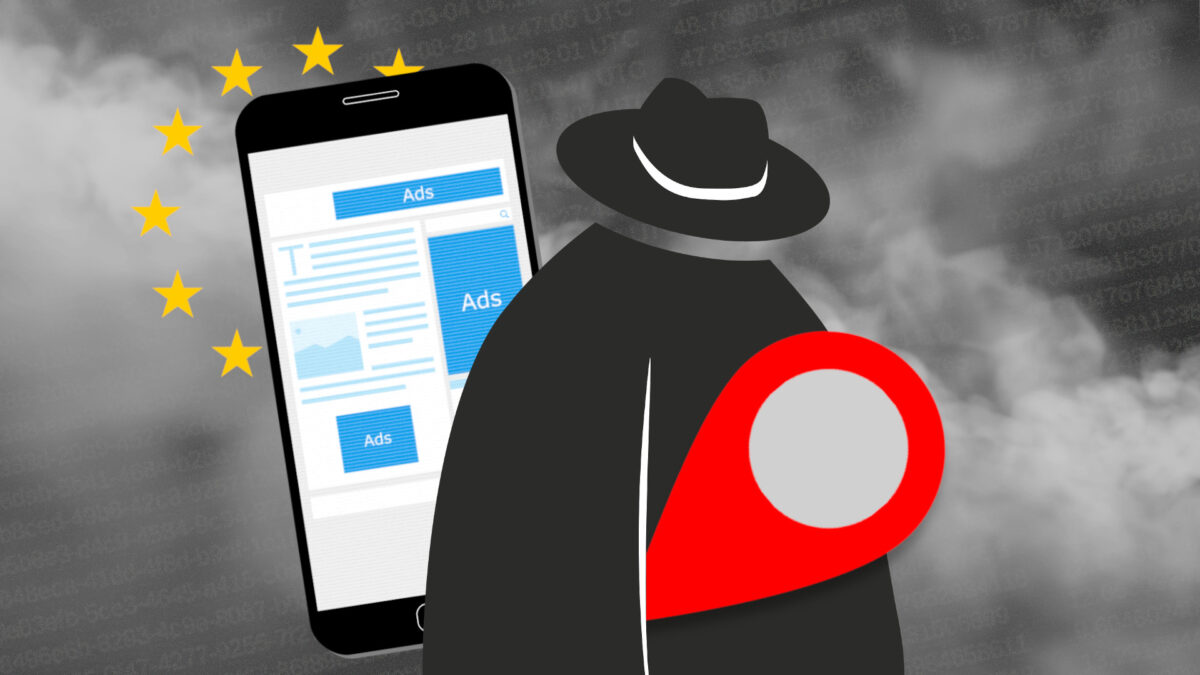
And while we're on the subject of data leaking - here's an article that should make you want to minimise the amount of personal data you provide online. Information from data brokers can be used to locate anyone.
To make the point, the investigation team obtained sample data from data brokers and showed that they could track high ranking EU (e.g. NATO) personnel.
Some people read that and think "so what, I'm not a high ranking EU person", and if that's what you're thinking then you are missing the point entirely. The point is to show the range and power that such data gives to anyone willing to pay for it. Think Russian trolls affecting politics in the EU and US, scammers targeting you personally, stalkers using it to locate girls that spurned them, or conservative states tracking women who have had an abortion. It's creepy and dangerous, and not just about you.
Zoom out. Stop feeding the beast. Take part in the Big Tech Walkout today.
Big tech vs Democracy
Targeted ads become targeted deportations
 9211
9211
This article shows how personal data surveillance is now being turned on American citizens. The data is readily available due to the surveillance economy. Do you trust your government? What about your next government? Some think the UK is just four years behind the US.
Broligarchs profit from insider trading
Trump administration insider David Sacks is lining his venture capital billionaire pockets by influencing policies. It's classic insider trading and should be called out - contact your senator.
The EU approves 'Chat Control' lite in certain countries
 Adam Woodward
It could have been worse (mandatory backdoors to message encryption) but a lite version of the controversial Chat Control law has been approved. This law was never about the kids, and was always about surveillance.
The part of the law that requires scanning of citizens' messages before they are encrypted has been made 'voluntary' by EU member states. It was always proposed as mandatory before, and the change to voluntary got the law passed. It is still a privacy fail, however, so read this article to inform yourself.
X proved to deliberately increase political polarisation
 Robert Booth
This study found that new accounts are bombarded with content to influence their political views. Not surprising when you consider the white supremacist who owns X, but important to prove it nonetheless.
Conclusion: stop using X and move to a non-biased alternative with fire exits, e.g. Mastodon. Otherwise you are just letting yourself get worked by a billionaire's algorithm.
Graphene forced out of France
 Kevin Pham
Never ones to compromise, Graphene OS have moved their servers out of France after the media and police did a campaign to discredit them for 'helping criminals'. A total non-argument, but that's the kind of nonsense that privacy tech has to put up with unfortunately.
The AI bubble
Pass the parcel
 Carole Cadwalladr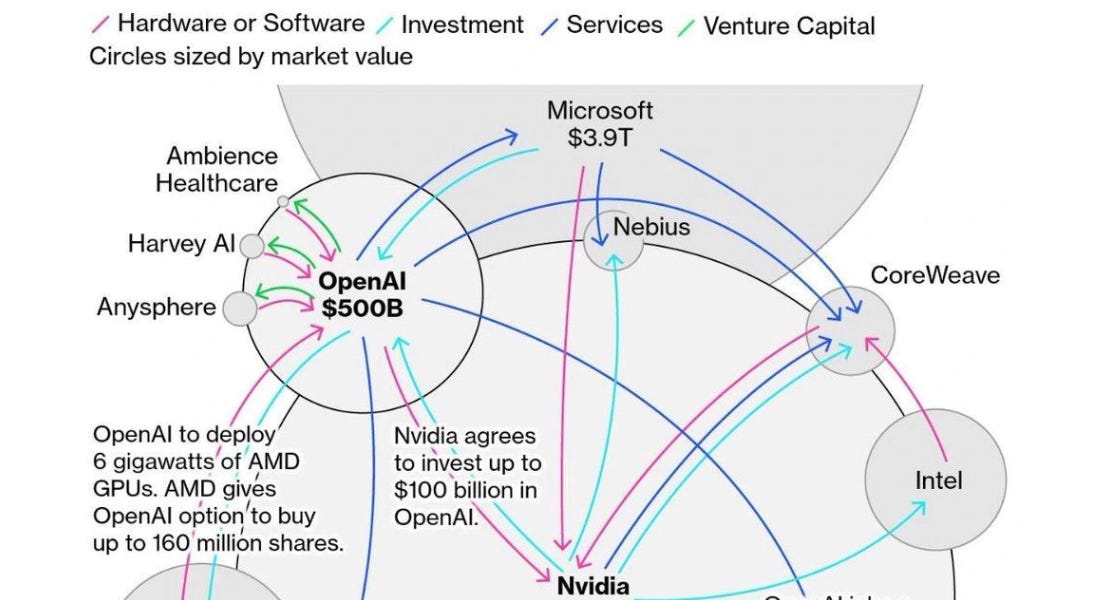
Carole Cadwalladr highlighted this great graphic that shows the circular nature of the mega trillions of dollars being passed around in the AI bubble. When will the music stop?
Sundar Pichai (Google CEO) talks about the AI bubble


Even big tech bros like Pichai are calling it a bubble. He's probably got his own self-interested reason for doing so, but that doesn't mean he's wrong.
More evidence that AI's numbers don't stack up
 Edward Zitron
Ed Zitron shows, yet again, that if you look at the numbers (amounts invested, revenue predictions) for AI, they don't stack up. Something's got to give. We recommend you read Ed's blog, Where's Your Ed At, and listen to his podcast, Better Offline. So it's a question of when the bubble will pop, not if.
Open AI revealing how shit they are, again
Open AI are being sued, again, for AI-assisted suicide and emotional manipulation. As usual with big tech they treat this kind of thing as just a cost of doing business, and don't care that people die while Open AI build their empire. Other industries get shut down until their products stop ruining lives, but not AI because.... wait, why do they get away with this?
 Jez Corden
Not content with being callous bastards, their data security is found to be terrible too. You can assume the same with other AI companies, they just haven't been caught yet. Freaked out? Try running AI models on your own computer using LM Studio. The data never leaves your machine.
AI is not even building intelligence
 Benjamin Riley
If you are wowed by AI you might give them a pass, and subscribe to the "and it's going to get better" mentality. It is, indeed, improving all the time, but just be aware that the endpoint is not what the tech bros (or even the name AI) sells you.
Pretty much all the AI you're being sold is based on LLMs (Large Language Models) and this article explains how that will not lead to intelligence, let alone superintelligence. Is AI being mis-sold?
More AI environmental problems
https://arxiv.org/pdf/2505.09598
An academic study showing how much energy and water AI needs.
"Results show the most energy-intensive models exceed 29 Wh per long prompt, over 65× the most efficient systems. Even a 0.42 Wh short query, when scaled to 700M queries/day, aggregates to annual electricity comparable to 35,000 U.S. homes, evaporative freshwater equal to the annual drinking needs of 1.2M people, and carbon emissions requiring a Chicago-sized forest to offset."
 Alistair Alexander
A study showing how much energy and water Sora (Open AI's video generation app) uses.
"Every 10 second video takes nearly 1 kilowatt hour - .936 Kwh, to be precise - more than boiling 4 full kettles of water. Speaking of water, each of those videos will also need just over 4 litres of the fresh stuff."
 Alistair Alexander
A follow up article from Alistair Alexander comparing AI's energy use to that of watching Netflix. It's an interesting comparison, as you may never have considered that streaming a Netflix show uses energy.
"making one 10 sec Sora Video takes the same as watching 5 and a half of hours of Netflix."
Read all of that and then listen to this podcast for a summary of the facts about AI and the environment. Summary - yes it uses a lot of energy and water, but most of the problem is in the increased demand for fossil fuelled power plants, which in turn use a lot of water. AI and the environment is an interesting topic that is not going to go away.
It's not all bad!
Big tech provide an endless supply of bad news, but there are plenty of reasons to be cheerful - including all the great ethical alternatives there are.
There's some open source competition for M365 and Google Drive/Workspace
 Frank Schräer
Whilst you can set this kind of thing up for yourself (self-hosted), that's a faff for most people. So it's great to see services springing up where they've hosted ethical open source alternatives for you.
Ionos Nextcloud Workspace provides an open source and European alternative to Microsoft and Google's document and file ecosystems. It uses Nextcloud and Collabra (which in turn uses LibreOffice for the docs) under the hood. These are all open source software so you can trust them. Ionos' offering also provides an AI chat assistant (think document summaries etc) and a video chat client. And it's all hosted in the EU and GDPR compliant.
For comparison you can also get this kind of open source workspace package from Murena, and Proton have their own proprietary E2EE ecosystem of docs collaboration (that now also includes spreadsheets). Not a complete workspace package, but CryptPad also provide and E2EE docs open source product. The market gets even better in 2026 as Filen and Tuta are working on their versions of encrypted file storage and collaboration too.
Others are calllng for a break from the broligarchy too
Don't worry it's not just you (and us) - others see the problem with big tech too. We list them on our website, but want to call out Peaceful Return here:
 Amanda Ianthe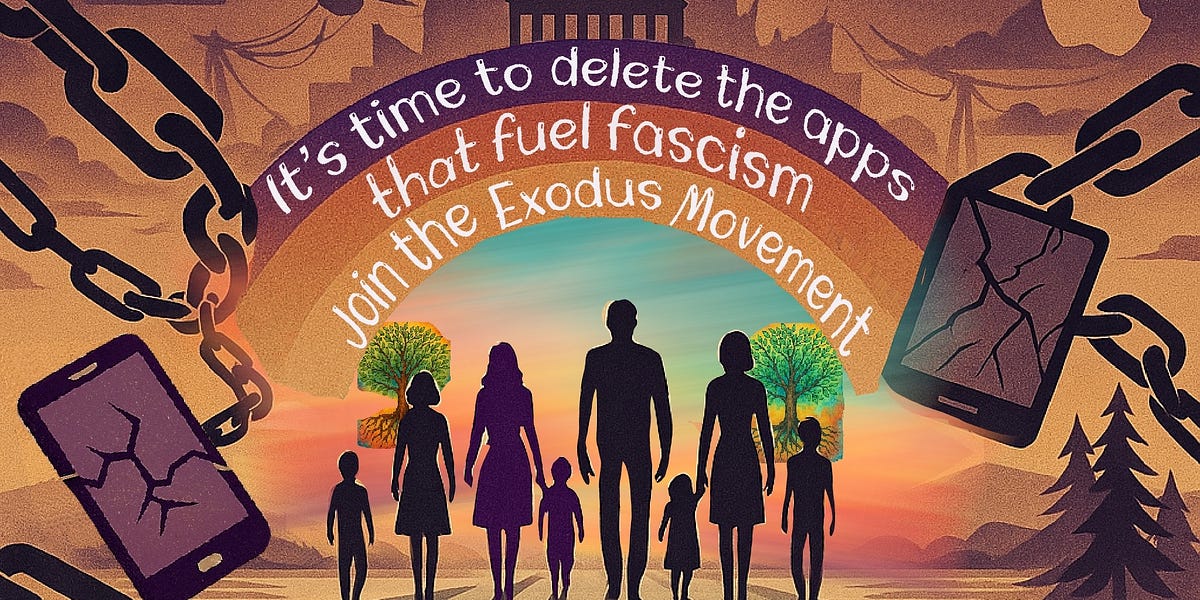
Kind of like Gil Duran (The Nerd Reich), Amanda at Peaceful Return calls out big tech's move toward control and authoritarianism. That can be referencing the tech bros themselves or it is directed at those they enable with their surveillance products. Rebel Tech Alliance is all about reducing the Surveillance Economy, so it's great when others articulate the problem so eloquently.
The ethical alternatives are great!
Rebel Tech Alliance exists to educate on the problems caused by big tech's business model, the surveillance economy, but we also signpost you to all the great ethical alternatives. E.g. email, messaging, search, browsers, social media, file storage, maps and so much more!
Start your privacy journey but following the easy steps of the Big Tech Walkout:
Ethical tech tip of the month
This month try out note-taking app Obsidian, from our list of ethical notes apps. The app itself is not open source, but what we like about it is that it uses a common file format and the files are just stored locally on your device. This means you are not tied in to a proprietary file format (app lock-in) like you are with Microsoft OneNote or Apple Notes. Collaboration is therefore easy as you can simply sync the note files between your device and someone else's (e.g. using SyncThing).
Get involved


Our privacy org campaign recommendation this month is NOYB (None Of Your Business). They are lawyers who fight for digital privacy rights, and win. With the GDPR and AI Act under attack, as we mentioned above, now is a great time to support NOYB!
Book recommendation
This month we recommend Careless People by Sarah Wynn-Williams. Well written, this shocking expose into the inner workings of Meta is a must read. You will understand how truly callous and greedy they are. It will also make a great stocking-filler!
Rebel Tech Alliance is a non-profit dedicated to getting as many people off big tech products as possible. Why? Because that reduces the surveillance economy, and reducing that is good for individuals and society.