The Billionaire Mind Virus
A deep dive into the psychology of tech billionaires, so you understand why they are such a threat.

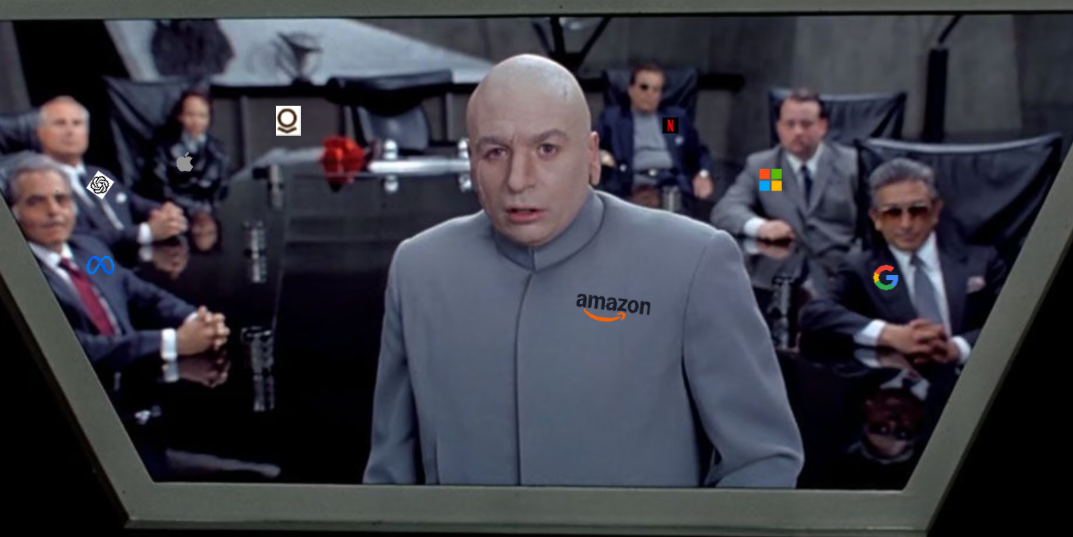
Definition
Our research on big tech has led to discovering the breath-taking scale of wealth that they have amassed. I personally have a theory that huge amounts of money corrupts and changes you, regardless of the industry you work in or how you got the money. And the form that the corruption/change takes is to isolate you from 'normal' people and to make you despise them. I call this condition the Billionaire Mind Virus. This is a reference to Elon Musk's use of the phrase 'the woke mind virus' and flips it to point back at the likes of him: isolated, people-hating billionaires.
The scope of the problem
First of all you need to realise that these people are operating at a different scale to millionaires: how much is one billion? Technically it is 1000 million, but how do you visualise that?
This website does it by showing you 1 million pixels in a block that you scroll down, and then you get bored trying to scroll down through to the end of 1 billion.
Another way is to think of 1 million or 1 billion seconds:
| Amount | Seconds | Days | Years |
|---|---|---|---|
| 1 million | 1,000,000 | 12 | 0.03 |
| 1 billion | 1,000,000,000 | 11,574 | 32 |
1 million seconds is 12 days; 1 billion seconds is 32 years. So billionaires are counting in a different scale to millionaires. They are much richer, and therefore wield much more power than millionaires.
According to Forbes there are now about 3000 billionaires in the world, collectively worth about $16 trillion. The U.S. has 902 billionaires, followed by China (516, including Hong Kong) and India (205).
It's worth noting that the figures used to quantify how rich someone is are based on stock prices, which means that to a certain extent these values are based on the market and are subject to change. Despite them not being 'cash' figures, these numbers still allow these people to command huge power, and therein lies the problem.
So, who are they?
World Billionaire list 2025
Here are the top 25 billionaires in 2025 (as of April 2025) followed by other notables that are relevant to our research on big tech. Notice how it is dominated by people from the United States, and those that work in the Technology industry.
Source: https://www.forbes.com/sites/chasewithorn/2025/04/01/forbes-worlds-billionaires-list-2025-the-top-200/ (with n/a ones added manually by me)
| Rank | Name | Net Worth | Country | Source of wealth | Industry |
|---|---|---|---|---|---|
| 1 | Elon Musk | $342 B | United States | Tesla, SpaceX | Technology & Automotive |
| 2 | Mark Zuckerberg | $216 B | United States | Facebook (Meta) | Technology |
| 3 | Jeff Bezos | $215 B | United States | Amazon | Technology |
| 4 | Larry Ellison | $192 B | United States | Oracle | Technology |
| 5 | Bernard Arnault & family | $178 B | France | LVMH | Fashion & Retail |
| 6 | Warren Buffett | $154 B | United States | Berkshire Hathaway | Finance & Investments |
| 7 | Larry Page | $144 B | United States | Technology | |
| 8 | Sergey Brin | $138 B | United States | Technology | |
| 9 | Amancio Ortega | $124 B | Spain | Zara | Fashion & Retail |
| 10 | Steve Ballmer | $118 B | United States | Microsoft | Technology |
| 11 | Rob Walton & family | $110 B | United States | Walmart | Fashion & Retail |
| 12 | Jim Walton & family | $109 B | United States | Walmart | Fashion & Retail |
| 13 | Bill Gates | $108 B | United States | Microsoft | Technology |
| 14 | Michael Bloomberg | $105 B | United States | Bloomberg LP | Finance & Investments |
| 15 | Alice Walton | $101 B | United States | Walmart | Fashion & Retail |
| 16 | Jensen Huang | $98.7 B | United States | Nvidia | Technology |
| 17 | Michael Dell | $97.7 B | United States | Dell Technologies | Technology |
| 18 | Mukesh Ambani | $92.5 B | India | Diversified | Diversified |
| 19 | Carlos Slim Helu & family | $82.5 B | Mexico | Telecom | Telecom |
| 20 | Francoise Bettencourt Meyers & family | $81.6 B | France | L'Oréal | Fashion & Retail |
| 21 | Julia Koch & family | $74.2 B | United States | Koch, Inc. | Diversified |
| 22 | Charles Koch & family | $67.5 B | United States | Koch, Inc. | Diversified |
| 23 | Zhang Yiming | $65.5 B | China | TikTok | Technology |
| 24 | Changpeng Zhao | $62.9 B | Canada | Cryptocurrency exchange | Finance & Investments |
| 25 | Jeff Yass | $59 B | United States | Trading, investments | Finance & Investments |
| 82 | Eric Schmidt | $24 B | United States | Technology | |
| 87 | Rupert Murdoch & family | $23 B | United States | Fox News; The Times; WSJ | Newspapers, TV network |
| 131 | Peter Thiel | $16.3 B | United States | Palantir; Facebook; Venture Capital | Technology |
| 311 | Brian Chesky | $9.2 B | United States | AirBnB | Technology |
| 329 | Nathan Blecharczyk | $9 B | United States | AirBnB | Technology |
| 361 | Alexander Karp | $8.4 B | United States | Palantir | Technology |
| 364 | Joe Gebbia | $8.3 B | United States | AirBnB | Technology |
| 401 | Daniel Ek | $7.8 B | Sweden | Spotify | Technology |
| 1015 | Travis Kalanick | $3.6 B | United States | Uber | Technology |
| 1513 | Reid Hoffman | $2.4 B | United States | Technology | |
| 1850 | Marc Andreessen | $1.9 B | United States | Andreessen Horowitz (Venture Capital) | Technology |
| n/a | David Sacks | $1.7 B | United States | Pay Pal; Venture Capital | Technology |
| 2233 | Sam Altman | $1.5 B | United States | Open AI; Y Combinator | Technology |
| n/a | Satya Nadella | $1.5 B | United States | Microsoft | Technology |
| 2790 | Sundar Pichai | $1.1 B | United States | Technology |
The total $ of net worth in the technology industry (from the list above) is $1832 B.
For context the total 'budget deficit' of the UK (the amount we borrow more than we have) is currently $124 B, and Oxfam state here that it would take about $40 B investment until 2030 to end world hunger - that's $240 B if you count 2025. If you're thinking "But it's governments that are supposed to donate to end world hunger" that's why I included the UK's current deficit: the amount of wealth concentrated in the hands of private individuals dwarfs the financial problems that entire nations, or even groups of nations, have to contend with.
For an illustration of how quickly these oligarchs accumulate wealth watch this video from Robert Reich:
"In just 13 minutes Jeff Bezos makes what a typical person makes in a lifetime"
What about UK and European billionaires?
The list of top 20 UK billionaires tops out at $47 B, and so don't even make it into the top 25 in the world. Two of them, Gopi Hinduja and Jim Ratcliffe, appear in the European top 20, which tops out at $158 B. So although inequality is a worldwide problem, the USA really is on a different scale when it comes to wealth concentrated in few hands.
Built different
The main point of this blog post is to show how billionaires are fundamentally different to ordinary people, not just in terms of bank balance but in terms of psychology. You will then know that they cannot be trusted and you must avoid them and their products. However we'll start with non-psychology aspects: wealth management and politics.
r > g
Many people think that billionaires are just very wealthy versions of the rest of us, and we can emulate them if we work hard enough. But since R > G, i.e. the rate of return on capital is greater than than the rate of growth of the economy, actually when you amass great wealth into a single individual or company, the population at large has no chance of catching up via 'normal' means. In other words you can't get as rich as them via your salary and pension, a few investment properties and some modest investments. The very wealthy are starting from the advantage that the millions they inherit (or own from their companies due to being the majority shareholder) make far more money in the hands of a wealth manager. Money makes money faster than you can make money via labour.
Citizens United - buying influence
In the US, the mega-rich have an other advantage: the ruling in the 2010 Citizens United vs FEC case. This allowed them to pump masses of cash into political campaigns, which until then had been restricted. Now they could buy the tax breaks and lack of regulation that would keep them and their companies mega-profitable.
Isolated from the great unwashed
How are billionaires different psychologically, and why is that the case?
In this New York Times opinion piece, film production company exec Michael Hirschorn compares the modern day tech billionaires to Louis XV. (Quick history lesson: Louis XV sowed the seeds of the French revolution (and the dissolution of the monarchy) by centralising power and blowing all the kingdom's cash. Louis XVI and Marie Antoinette are more famous for this, because they were the ones in power when the revolution came, but it was Louis XV that set the tone.)
I encourage you to take a break now and read that whole article yourself - it's full of great insights (and it's a gift article so not behind a paywall). For the purposes of this article, however, I want to call out that he mentions how isolation and only talking to other billionaires creates (what I'm calling) the billionaire mind virus.
"the super rich have allowed themselves to become increasingly isolated. An ever-more-stratified scale of luxury allows the staggeringly rich to avoid coming into contact with even the merely wealthy, let alone the rest of the world, “to glide through a rarefied realm unencumbered by the inconveniences of ordinary life,”
Further corroboration of this comes from Chuck Collins, an academic who studies economic inequality, who has stated that wealth is a "disconnection drug":
"Privilege or wealth is a disconnection drug that keeps people apart from one another and from building authentic real connections and communities. When you have that kind of wealth, you don't really have to ask for help - you could buy all the services you need, but then you miss out on reciprocity, that important part of human existence, which is 'I need help, can you help me' and the vulnerability and connection that is created by that"
If you want a proper in depth study on the "social arrogance of the privileged" then this review of José Medina's book The Epistemology of Resistance is a great read:
Medina highlights the virtues of
"humility, curiosity/diligence and open mindedness, in contrast to the epistemic vices of arrogance, laziness, and close-mindedness."
So at their core billionaires are broken - they lack the ability to form real human connections. The lack real community. This goes a long way to explain how they develop the traits of sociopaths: lack of empathy, manipulative behaviour, control, superficial charm.
Their disconnect from normal people is a weakness that should be mocked and exploited.
Let them read crap
The NYT article above also contains this quote:
"Billionaires control the cable channels, social media platforms, newspapers, movie studios and essentially everything else that we consume, but for their own information sources they are in some cases more likely to trust their own kind."
This is important - they control the algorithms that control what we, the people, see as news. But they don't rely on those news feeds (which has echoes of tech bros not letting their children use social media) and instead have their own filter bubble - ideas only shared in billionaire circles. Also referenced in the NYT article is a piece by Semafor that shows how certain billionaire group chats have corralled their filter bubble to focus on hard right politics. This has become relevant as the likes of Elon Musk, David Sacks and Peter Thiel burrow their way in to US politics, and have begun meddling in EU politics to encourage far right political parties.
So when we decry the lack of truthful, fact-checked information we are being fed, instead of "Let them eat cake", the broligarchy might respond with "Let them read crap".
Don't allow these billionaire elites to spoon feed you their biased agenda to your 'feed'. Start your own move away from billionaire algorithms by taking part in the Big Tech Walkout now:
Historical context
But hasn't this always been going on? In many ways yes but lately things are worse - and perhaps coming full circle to the age of monarchy. This article references the US oil billionaires that built up their wealth since the start of the 20th Century:
The interviewee is Chuck Collins, an academic who gave away a large part of his inheritance. The point he makes in this interview is that billionaires used to be taxed appropriately, and so the idea that 'the rising tide floats all ships' held true, but over time this has stopped being the case. Inequality has increased a huge amount, particularly since the 1980s. And since money makes money, as we described in the 'r > g' section above, the gap widens faster and faster over time if nothing is done to curb it.
Collins points out that, starting with the US oil billionaires,
"you had a segment of business owners who invested heavily in shaping our political system. And that included an aversion to taxation, government regulation, and a clear path for unbridled energy extraction in the fossil fuel sector. So you have this one powerful segment of the economy and individuals in the economy, rigging the rules, if you will."
And of course, as pointed out above in the 'Citizens United' section, this problem became much worse since 2010.
Tech bro billionaires
So now we know who these people are, that wealth on the billionaire scale corrupts the mind, and that the problem is getting exponentially worse, let's take a closer look at the current crop of tech bro billionaires, and the weirdness that comes specifically with them.
Bunker mentality
One of the more striking aspects of the tech bro billionaires (or the 'broligarchy' as they're also known) is that they are not quiet about their wealth, and they openly prep for it all going wrong. This article from 2024 first let the public know that tech bro billionaires are actually serious about building doomsday bunkers: https://www.vice.com/en/article/billionaires-are-building-luxury-bunkers-to-escape-doomsday/ (plus https://youtu.be/uQin210ZBAQ - VICE TV feature on the same source, Douglas Rushkoff )
These sociopaths are happy to exploit the rest of us mercilessly, and if it all goes wrong then they have prepped for that by building luxurious bunkers in, for example, New Zealand or Hawaii. So they are immune from the current consequences of their actions and think they'll be immune to future consequences too. I hope, as pointed out in that Vice article, that the bodyguards shoot them.
Brooke Harrington is an academic who studies the rich, and her website features this YouTube video of her on the Daily Show. It's well worth a watch, pointing out that "the broligarchy has an anti-democratic political agenda that is almost monarchical" and goes beyond oligarchs of the past who just wanted less tax and less regulation. This is an important point - that they are different from oligarchs of the past. Not only are they "released from the social norms of the past" that said it was unacceptable to flaunt your wealth with no philanthropy, but these ones come with cult-like overtones that believe in weird ideologies.
TESCREAL
Timnit Gebru and Emile Torres coined the acronym TESCREAL to group together the ideologies that the tech bros have hijacked. These two academics have done great things warning us about the dangers of big tech's approach to AI, and the apocalyptic framing that tech bros are increasingly using. TESCREAL stands for Transhumanism, Extropianism, Singularitarianis, Cosmism, Rationalists, Effective Altruists and Longtermism.
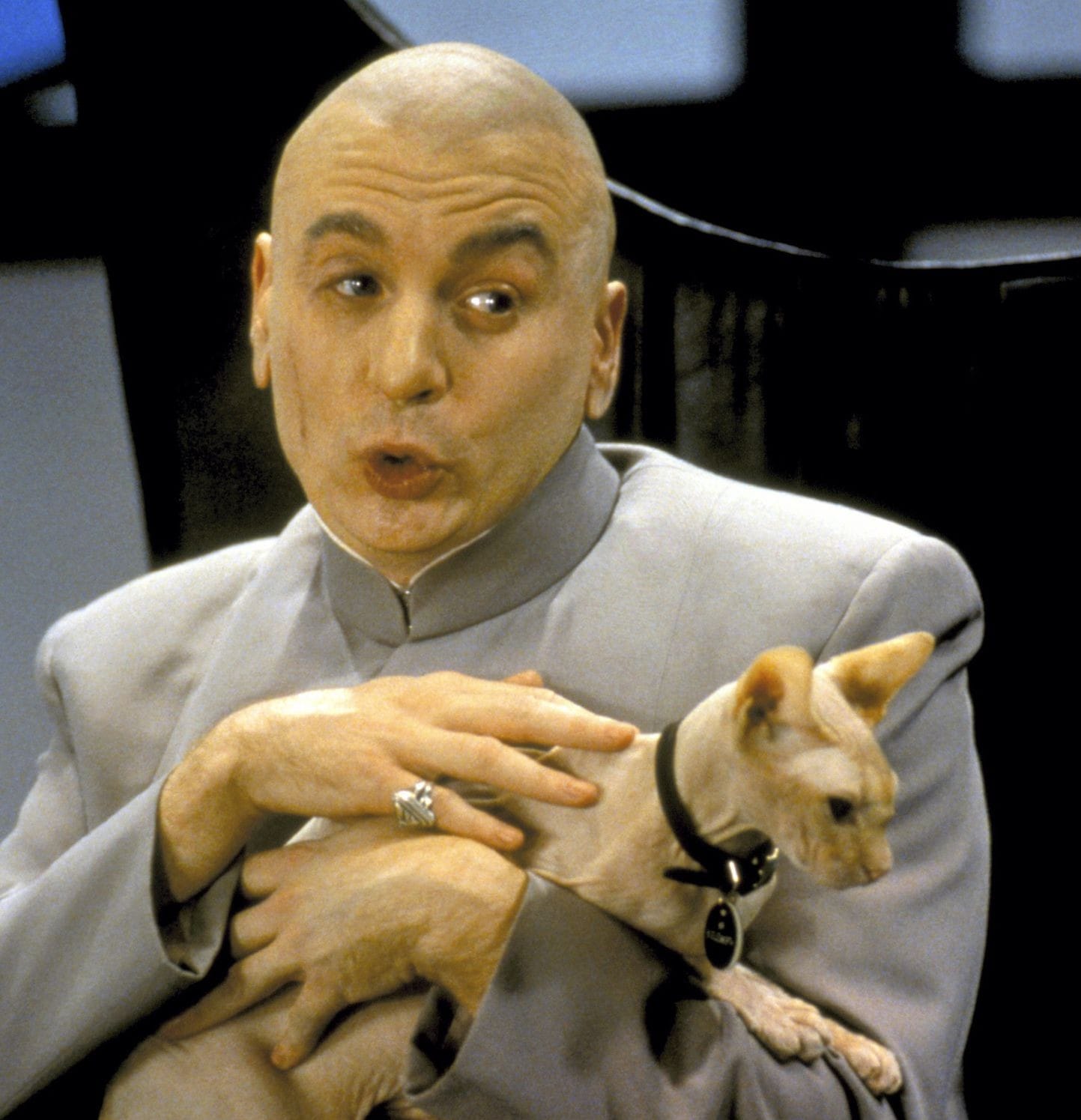
This is a subheading of the 'Bunker mentality' section because this combo of beliefs, particularly the fusion of effective altruism and longtermism, have spawned an apocalyptic mentality in these sociopaths. When they talk about the 'existential threats' of AI it's unclear if they really mean the terminator scenario, or whether they're predicting that we, the people, will finally rise up and destroy them. And so they're prepping by building bunkers. They are literally like Bond villains at this point (or perhaps closer to Dr Evil).
I recommend you take a look at Torres' blog Realtime Techpocalypse for an informed view on this stuff. Also look at Gil Duran's blog The Nerd Reich (and his podcast). They have insider knowledge, do great research, and will show you just how weird these tech bro billionaires really are.
Pesky humans
One thing to note is that those ideologies are not necessarily that bad in and of themselves, they've just been hijacked and combined by the tech bros. For example, transhumanism, the belief that we can advance the human condition via technology. Sadly tech bro billionaires like Peter Thiel are highly selective about this and he doesn't really want humans to survive . But he, himself wants to live forever (he has invested millions in life longevity research, as have most of the tech bros). In 2018 he denied being a vampire, but in 2025 it's looking inconclusive.
Elon Musk believes that 'better people' (by which he means white people like him) should have as many children as possible to try to out breed the unintelligent masses. He currently has 14 children from various mothers. A classic white supremacist mindset mixed with the billionaire mind virus. He's happy to sell you a car full of tracking software, but he'd really rather you don't exist. Source: the podcast "The Making of Musk".
Nothing special
I can't find the source of this quote right now, but it fits with tech billionaires: "Billionaires think that just because they have succeeded at capitalism, and no one has ever stopped them, their ideas should be imposed on everyone else". Add to that 'succeeded at global tech networks' and the hubris is off the scale. And then add to that their osmosis into the American government and their heads are so big they're rivalling Mount Rushmore. But really all they've done is mercilessly mine unrestricted free market capitalism, and all the benefits that practically zero regulation the tech sector has specifically accrued in the last 25 years. That does not take skill, and it certainly doesn't take character. It takes ruthlessness and the kind of careless nature that's a hallmark of sociopaths.
Compulsive liars
And if that wasn't bad enough - being sociopathic oligarchs with an anti-human manifesto - they're compulsive liars too. Sam Altman, CEO of OpenAI, is the liar in chief. This YouTube video gives a good flavour of his level of bullshit. Look at the montage of bullshit claims he makes, starting from one minute in. A classic confidence man. The massive claims made by AI boosters are just the latest in a long line of "Just trust me, bro" bullshit claims made by big tech over the years.
That video also highlights a classic moment when someone called him out on AI's dodgy finance numbers and he just say "well sell your stock then". If you've come up through the world of raising finance via Venture Capital, then pretending to save the world but actually just lining your own pockets is second nature.
The traits and causes outlined in this article make it easier to see how Trump et al. seem to lie so easily. It is easy to lie when your morals are gone and all you want is more power. After all you're only lying to common people, and they're not real. Only your fellow billionaires are real.
Liars or bullshitters?
This is an interesting distinction. A liar cares about the truth, because they want you to believe the opposite. A bullshitter doesn't care about the truth because they just want you to believe whatever will benefit them. Under this definition the tech bros, and their colleagues in the US administration, are actually bullshitters, not liars. Steve Bannon taught them well - just "flood the zone with shit".
Is no one else seeing this??!
Are all billionaires like this? The theory is that yes, they are, because the money corrupts them. However every rule as a few exceptions. But does no one break ranks?
Beyond Chuck Collins, quoted above in the 'Isolated' section, there is another high profile example of a rich person not only criticising the wealthy, but also giving up their wealth: Marlene Engelhorn. In this podcast episode we get a rare insight into Engelhorn, a rich person by inheritance, criticising the rich. She thinks they are feeble minded. She things that only the money gives them power and it buffers them from consequences.
My own observation is that wealth also protects people from having to think, they can afford to have everything done for them, so their critical thinking skills diminish considerably. Perhaps this is why they don't seem to mind that AI is reducing the critical thinking abilities of the wider population.
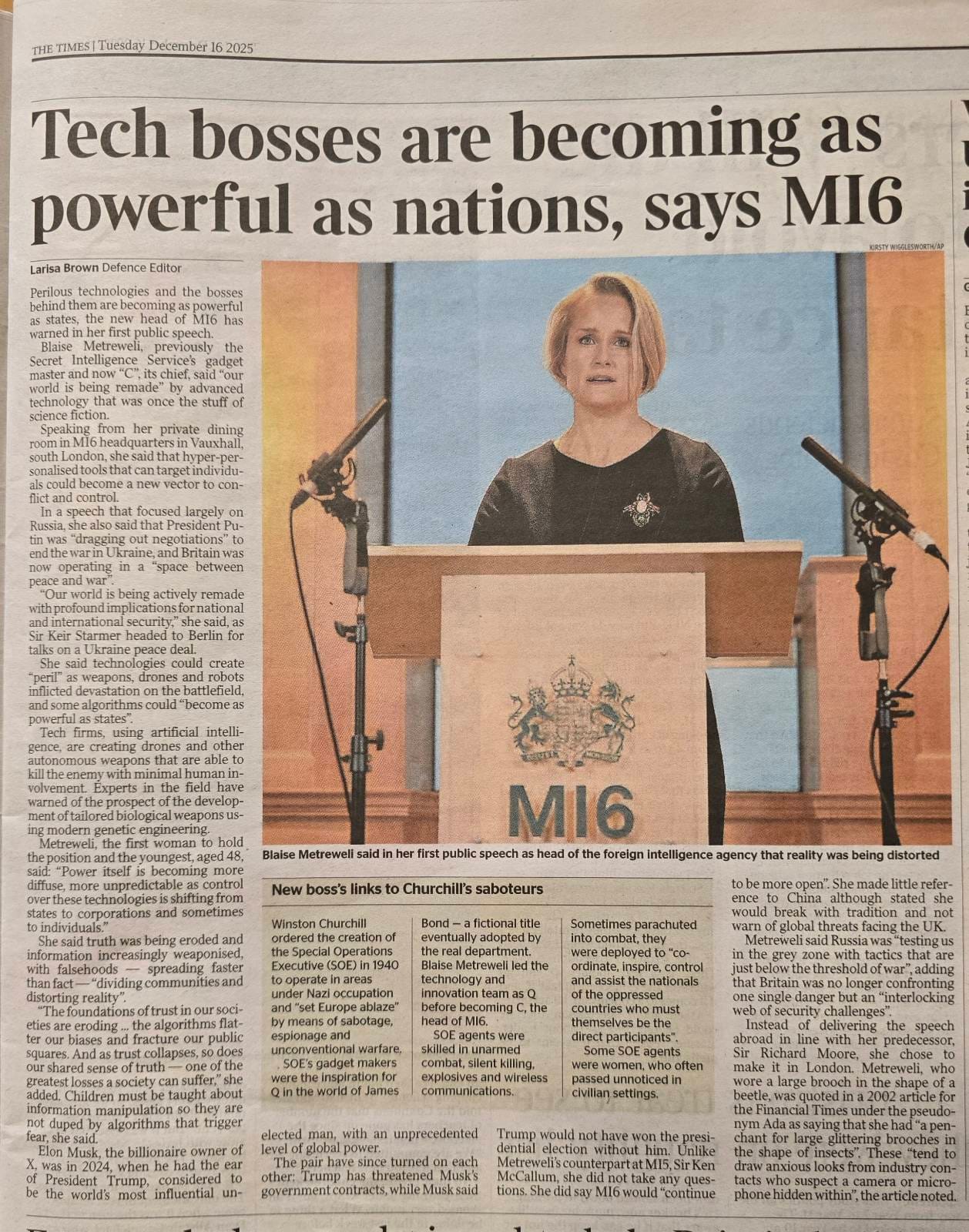
It was refreshing to see, in this Times article by the new head of MI6, some support for the view that tech bros and their products are bad for society. She name checks Elon Musk as the world's most powerful unelected person, and states that algorithmic undermining of truth is damaging society. Good to see that the head of a major government department has finally caught up with what we and many others have been saying all along.
Oxfam have also sounded the alarm on this - calling billionaires a threat to democracy! They also have a billionaire tracker, showing interesting comparisons on what their money could buy if used ethically.
And finally, Abigail Disney (a Disney family heiress) in this video describes "how inherited privilege breeds isolation, erodes empathy, and distorts democracy itself".
Conclusion
Now you know who these people are, the scale of their wealth, and that they have been warped by that wealth to be untrustworthy sociopathic bullshitters. And we've seen that they share a weakness: an inability to connect on a human level.
Now remember that these people run the few tech companies that decide what billions of people see, think and feel. Culture always trickles down from the top in companies, so with uncaring sociopaths at the top, you're going to get a cesspit product.
We've also looked at how they became billionaires, and whilst we found macro elements that have accelerated it, sadly we've partially got ourselves as individuals to blame. Big tech got so big in part because we accepted the free gadgets and services in exchange for surveillance. We all drank the Kool-Aid (myself included) and now we've got weird Bond villains meddling in global politics. It's time to starve the broligarchy of the raw material they covet so much - our data. Make your stand by starting to run ethical tech in parallel, and then eventually break free from big tech and its creepy, people-hating billionaire owners!
Starve the broligarchy - follow the easy steps of the Big Tech Walkout. Push the big red button:
Tech tip of the week
For watching Youtube videos with no tracking by Google, paste the video URL into the DuckDuckGo browser. For a more YouTube app-like experience - on desktop - use FreeTube. This achieves the same thing - allowing you to watch videos without Google adding to a permanent creepy profile they hold on you.
Film recommendation
Moutainhead (2025). From the person who wrote Succession, this film perfectly captures the voice of tech bros (he listened to a lot of podcasts featuring tech bros). We see them count their billions as the world burns around them due to the release of genAI video capabilities (that flood the world with deepfakes). Very funny, but precient and alarming. Stars Steve Carell.
Book recommendation
Rewiring Democracy by Bruce Schneier & Nathan Sanders . Bruce Schneier is a cybersecurity expert who has been showing us for years how big tech claim to be good at security, at the expense of privacy, when in fact they're pretty bad at both. In this recent book he connects the dots to show (better than we do on our website) that tech is a threat to democracy.
Rebel Tech Alliance is a non-profit dedicated to getting as many people off big tech products as possible. Why? Because that reduces the surveillance economy, and reducing that is good for individuals and society.